
You're trading your most valuable asset for pennies while the product owners keep the real wealth. Are you genuinely satisfied with a 10% commission check that barely covers your monthly software overhead? Most creators enter this space looking for freedom but end up as glorified, unpaid interns for massive corporations. When you analyze affiliate marketing vs mrr in 2026, the choice isn't just about strategy. It's about survival.
I know you're exhausted from chasing leads for products you don't own and quality you can't control. You want a business that scales, not a job that requires you to be active every second of the day. This guide will show you why the traditional affiliate model is crumbling under shortened cookie windows and how 100% profit margins are the only path to consistent $10k months. You'll learn how to claim full ownership of your customer list and build an automated empire using frameworks like The Roadmap 3.0 and Digital Wealth Academy. We're stripping away the fluff to reveal the exact systems that turn digital products into high-velocity profit engines. It's time to stop building someone else's dream and start owning your own.
Key Takeaways
- Stop acting like an unpaid intern; learn why trading your traffic for 10% commissions is a recipe for professional stagnation.
- Analyze the brutal math of affiliate marketing vs mrr and see exactly how 100% profit margins accelerate your path to $10k months.
- Reclaim total control of your business by owning your customer list and lead data rather than gifting it to corporate brands.
- Identify the specific high-ticket assets, such as The Roadmap 3.0, that allow you to build a scalable empire instead of a temporary income stream.
- Leverage faceless marketing strategies to generate automated, passive revenue without ever needing to show your face on camera.
Digital Gold Rush 2026: Affiliate Marketing vs Master Resell Rights (MRR)
The creator economy is no longer a playground for hobbyists. It's a high-stakes battlefield where the winners build equity and the losers chase scraps. By mid-2026, the shift from "influence" to "ownership" has become absolute. If you're still relying on someone else's product to pay your rent, you're building your house on rented land. The market has matured. You have to decide if you want to be a middleman or a mogul. This choice defines your financial ceiling for the next decade.
To understand the landscape, we have to define the players. The Affiliate Marketing Model is the traditional middleman approach. You find a product, share a link, and collect a commission when a sale occurs. It's simple, but it's limited. On the other side, Master Resell Rights (MRR) represents the ownership approach. You purchase a digital asset once and gain the legal right to resell it as your own. You aren't just a promoter; you're the distributor. When you compare affiliate marketing vs mrr, you're comparing a paycheck to a portfolio.
Confusion often stalls beginners before they even start. The acronym "MRR" is the primary culprit. In the world of software (SaaS), MRR stands for Monthly Recurring Revenue. It's a metric. In the creator world, MRR stands for Master Resell Rights. It's a business model. Don't let the overlap in terminology distract you from the logic. One tells you how much you made last month; the other gives you the rights to keep 100% of what you make today.
The Two Faces of MRR: Licensing vs. Recurring Revenue
You must distinguish between a revenue stat and a legal license. Master Resell Rights is a strategic business model that turns a single purchase into an infinite inventory. It eliminates the need for product creation while maintaining the profit margins of a founder. You aren't just looking for a recurring check. You're looking for the right to scale without permission. This is why MRR is a fundamental shift in how digital wealth is built.
Why 2026 is the Year of the Digital Asset
Traditional affiliate cookies are crumbling. With 38% of programs now using attribution windows of seven days or less, your window to profit is closing faster than ever. Ownership is your only safety net. When you own the product, you own the customer list. You own the data. You own the entire profit margin. The psychological shift from "promoter" to "business owner" is what separates those struggling for pennies from those achieving $10k months. In 2026, the asset is everything.
The Affiliate Marketing Model: Low Friction, Capped Potential
Affiliate marketing is the ultimate gateway drug for digital entrepreneurs. You don't need a product. You don't need a support team. You just need a link and a dream. This low barrier to entry is exactly why thousands flock to it every day. But let's look at the brutal math. In the battle of affiliate marketing vs mrr, the traditional model often leaves you starving for growth. You spend hours creating content to drive traffic to a sales page you don't own. You're a lead generation machine for a brand that will eventually cut you out.
The cycle is simple: traffic, clicks, and a small cut. If you sell a $100 software subscription, you might see $20. That sounds fine until you realize you're doing 100% of the marketing for 20% of the reward. Most affiliates hit a brick wall at $1,000 per month. Why? Because you're playing a high-volume game with low-leverage tools. You're building their brand. You're giving them your customer's email address. You're essentially paying for their future growth with your current effort.
The Pros and Cons of Being a Promoter
The appeal is obvious. You avoid the "boring" parts of business. However, that convenience comes at a steep price. You have zero control over the sales funnel or the pricing. If the company decides to pivot, your income vanishes instantly. You're essentially a tenant in a building you'll never own.
- Pro: No customer support tickets or technical glitches to fix.
- Pro: No upfront product development costs.
- Con: Low margins. SaaS programs average 20-30%, but retail is often below 10%.
- Con: Zero control. They can change the price or kill the program tomorrow.
You are a tenant, not a landlord. If you want to stop being a middleman, you need to understand how to master digital wealth instead of just promoting it.
The 2026 Affiliate Reality Check
The landscape has become hostile. Major retailers like Amazon have slashed commissions to the bone. You might get 10% for luxury beauty, but most categories are far less. Competition is fierce. Everyone is fighting over the same saturated links. This saturation makes it nearly impossible to scale to elite levels without a massive, pre-existing audience.
Compliance is also tightening. The FTC is aggressively enforcing The 2026 Blueprint for disclosures. If you miss a single disclaimer, you face massive fines. Combine this with the fact that 38% of programs now have cookie windows of 7 days or less. If your lead doesn't buy immediately, you lose the sale. Affiliate marketing is a decent side hustle, but it's a poor foundation for a financial empire. It's time to demand more from your effort.
Master Resell Rights (MRR): The 100% Profit Revolution
Stop settling for crumbs. While affiliate marketers are begging for a 20% slice of the pie, MRR owners are eating the whole thing. The mechanics are simple. You purchase a high-value digital asset once. You gain the legal right to sell that exact product to your audience. The best part? You keep 100% of the revenue. Every single dollar. This isn't just a minor improvement in your bank account. It's a fundamental shift in how you value your time and traffic.
When you look at affiliate marketing vs mrr, the math is undeniable. To make $5,000 as an affiliate at a 10% commission, you need to move $50,000 worth of someone else's product. With an MRR course like Digital Wealth Academy, you only need to focus on your own bottom line. You aren't just a promoter. You are the owner of a Done-For-You (DFY) high-ticket funnel. This allows you to capture the full value of every lead you generate. More importantly, you own the customer list. In the digital economy, that list is your only true insurance policy.
The High-Ticket Difference
Most beginners fail because they chase low-ticket resell fluff that offers no real value. High-ticket MRR is different. You're selling comprehensive business systems like The Roadmap 3.0. These aren't just PDFs; they're deep-dive educational powerhouses. Selling a high-ticket product is often easier than selling a cheap one because the perceived value and transformation are significantly higher. If you want to scale, you need the Elite 2026 Scaling Framework. It's about volume meeting margin.
Branding and Control in the MRR World
Ownership means authority. You set the price. You control the customer experience. You decide how to bundle your assets to create a unique offer that no one else can match. Can you rebrand? Yes. Can you add your own bonuses? Absolutely. This level of control is impossible in the affiliate world. It also raises a common question: Is Master Resell Rights Legit? The answer lies in the quality of the product. When the education is world-class, the business model is bulletproof. You aren't just reselling a license. You're providing a solution and keeping the profit you deserve.
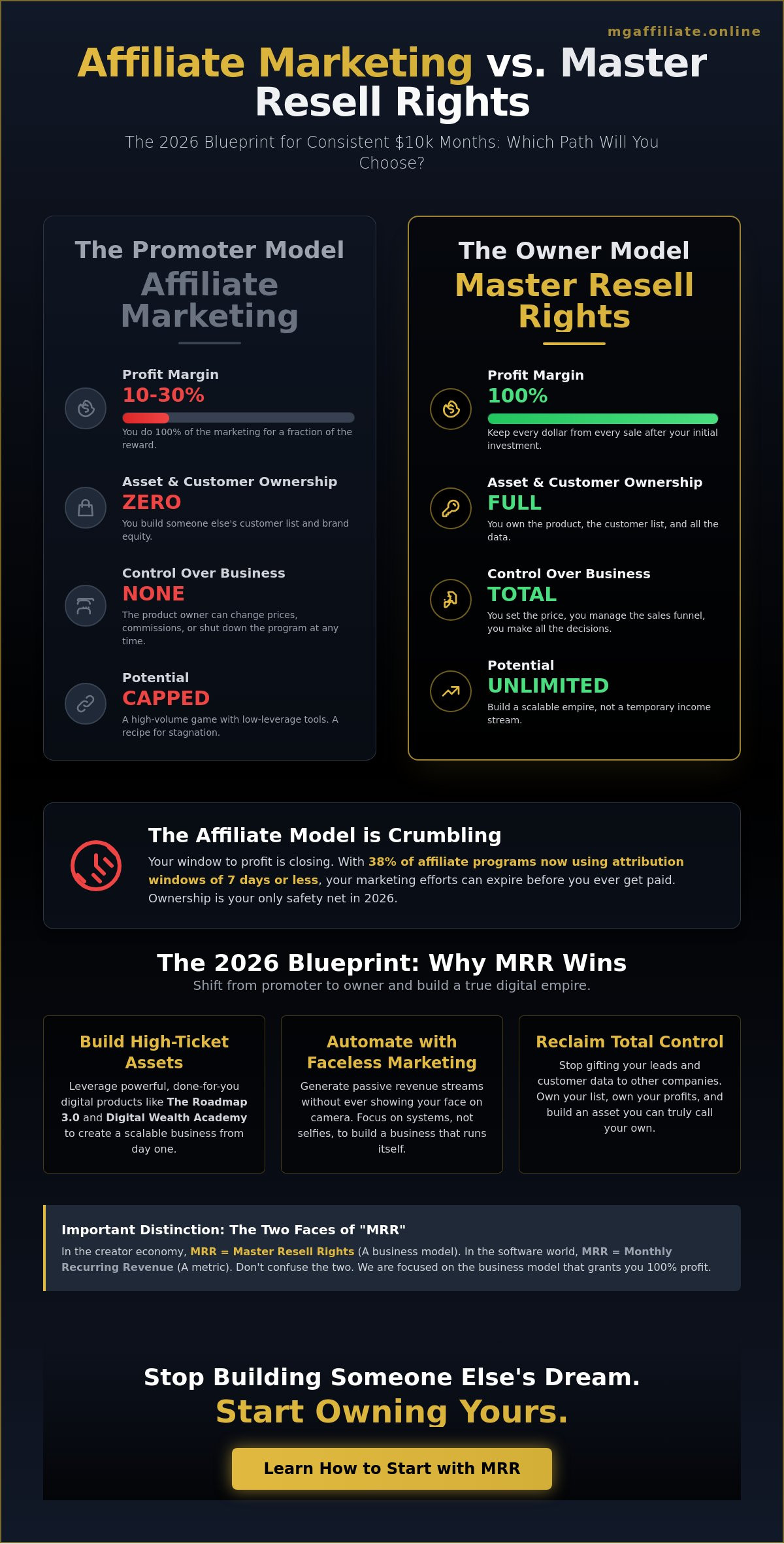
The Direct Comparison: Which Model Scales Faster?
Profit is the only metric that matters. When you analyze affiliate marketing vs mrr, the leverage gap is staggering. An affiliate marketer is a laborer. An MRR owner is a capitalist. One works for a percentage; the other owns the equity. This isn't just about making money. It's about how much work you have to do to keep it. If you're chasing a 20% commission, you're essentially working four days for the company and one day for yourself. Why would you accept those terms in 2026?
Ownership dictates your Customer Lifetime Value (LTV). As an affiliate, you're a lead-generation faucet for someone else's bucket. Once that lead buys, they belong to the brand, not you. You've lost the chance to upsell. You've lost the data. In the MRR model, every lead you capture is an asset you can monetize repeatedly. This control over the lead ownership is what allows a business to survive market shifts. You aren't just selling a product; you're building a database of buyers who trust your authority.
The "saturation" myth is a lie told by people who are afraid to compete. Quality education never saturates. The demand for high-level business skills is infinite. While startup costs for MRR are slightly higher than the "zero dollars" promised by affiliate marketing, the ROI is incomparable. You're paying for a business in a box, not a temporary referral link.
Effort vs. Reward: The Automation Factor
Lazy critics claim MRR is too much work. They're stuck in 2010. Modern systems have solved the delivery problem. With the right funnel, your product delivery, payment processing, and customer onboarding happen while you sleep. You set the system up once. It runs forever. This level of efficiency is how you build automated passive income streams without the constant need to hunt for the latest "hot" affiliate link. You're building a machine, not a treadmill.
The $10k Month Math
Let's look at the cold, hard numbers. To hit $10,000 as an affiliate with a $20 commission, you need 500 sales. That's a massive amount of traffic. If you own a high-ticket MRR asset like Digital Wealth Academy and sell it for $500, you only need 20 sales. Which path sounds more sustainable? The speed of scaling is directly tied to your margins. When you keep the full transaction, your budget for advertising and growth explodes. High-ticket ownership is the only escape from the grind of low-leverage promotion. It's time to stop thinking small.
Stop building someone else's empire and start scaling your own digital wealth today.
The 2026 Blueprint: Why High-Ticket MRR Wins
Execution is the only thing that separates a dreamer from a CEO. You've seen the math. You understand the leverage. Now you have to decide if you're going to keep playing the middleman or if you're ready to own the asset. In the debate of affiliate marketing vs mrr, the blueprint for 2026 is clear. You don't just want a product to sell. You want a foundation to build on. This requires a shift from a promoter mindset to a leadership mindset. Stop asking for permission to earn and start building a system that demands it.
The most successful creators this year aren't just reselling links. They're utilizing faceless digital marketing to build massive authority without ever showing their face on camera. This is the ultimate hedge against privacy concerns and social anxiety. You can build a multi-six-figure empire anonymously by focusing on high-value content and automated systems. When you combine this with 100% profit margins, you create a financial engine that is nearly impossible to stop.
The Roadmap 3.0: More Than Just a License
Don't mistake this for a simple resell scheme. The Roadmap 3.0 has become the industry gold standard because the education itself is the real asset. It teaches you how to build a business from the ground up, covering everything from legal structures to advanced automation. Whether you choose to resell the course or use the skills to launch a different venture, the knowledge is yours forever. You're joining a community of high-level strategists who understand that support and updated information are the keys to long-term scaling. This isn't a "one-and-done" purchase; it's an evolving business education.
Your first 30 days should follow a rapid implementation plan:
- Days 1-7: Complete the foundational modules and set up your automated sales funnel.
- Days 8-21: Launch your faceless content strategy and start building your own email list.
- Days 22-30: Optimize your conversion rates and begin scaling your traffic through reels and targeted messaging.
Final Verdict: Start Your Empire Today
The digital economy is moving fast. With tighter regulations and shrinking affiliate windows, the window for low-effort income is closing. You can continue to settle for crumbs while building someone else's dream, or you can own the bakery. The choice of affiliate marketing vs mrr is a choice between being a temporary worker or a permanent owner. The 2026 shift is here. Take the first step toward total ownership and start building a business that actually belongs to you. Success doesn't wait for the hesitant. It rewards the decisive.
Own Your Future Today
The numbers don't lie. You've seen the stark reality of affiliate marketing vs mrr. One model keeps you on a treadmill of low commissions and zero control. The other transforms you into a business owner with 100% profit margins and complete ownership of customer data. If you're serious about hitting $10k months, you can't afford to be a middleman any longer. You need a step-by-step automation blueprint that turns your effort into equity. Stop trading your time for pennies. The shift in 2026 is already happening, and the winners are those who own the assets. You have the potential to build something massive. Don't waste it on a referral link that could disappear tomorrow. It's time to step up, take charge, and build a business that actually pays what you're worth.
Stop Building Someone Else’s Empire—Get The Roadmap 3.0 and Keep 100% of the Profits Today
You're ready for this. The tools are waiting. Now, make the move that your future self will thank you for. Success is waiting for those brave enough to own it.
Frequently Asked Questions
Is Master Resell Rights (MRR) a pyramid scheme?
No, Master Resell Rights is a legitimate licensing model, not a multi-level marketing (MLM) scheme. In a pyramid scheme, your income depends on recruiting others into a "downline" to earn a percentage of their sales. With MRR, the transaction is direct and final. You purchase a digital product, you own the license to sell it, and you keep 100% of the profit. There are no uplines, no revenue sharing, and no ongoing obligations to the original creator once you've secured your license.
How is MRR different from Private Label Rights (PLR)?
The primary difference lies in the quality and the permissions granted. PLR usually allows you to strip the product apart, edit the content, and put your name on it, but the quality is often low-ticket "filler" content. MRR products like Digital Wealth Academy are high-ticket, finished educational assets. While you generally cannot change the core video content in an MRR course, you gain the powerful right to pass the resell rights along to your customers. This creates a much higher value proposition for your buyers.
Can I really make 100% profit with MRR?
Yes, because you act as the sole distributor of the asset. After you've recovered your initial investment, every sale you make goes directly into your bank account minus standard third-party payment processing fees. This is the defining edge in the affiliate marketing vs mrr debate. While an affiliate might wait thirty days for a 20% commission, an MRR owner receives the full transaction amount instantly. You aren't splitting the check with a corporate headquarters; you are the headquarters.
Do I need a large following to succeed with MRR vs affiliate marketing?
You do not need a massive following to see results. Success in 2026 is driven by targeted traffic and high-conversion systems, not ego metrics like follower counts. Many creators use the Ultimate Reels Guide to build a brand from zero by focusing on specific pain points and solutions. Because the profit margins are so high, you only need a fraction of the sales compared to traditional affiliate marketing to reach your monthly revenue goals. Quality leads beat a large, unengaged audience every time.
What are the legal requirements for selling MRR products in 2026?
Compliance is non-negotiable in the current digital landscape. Under California Law AB 2426, which took effect January 1, 2025, you must clearly disclose that the consumer is obtaining a license to the digital good rather than permanent "ownership" if you use terms like "buy" or "purchase." Additionally, the FTC's 2023 Endorsement Guidelines require you to disclose any material connection to the products you promote. Transparency isn't just a legal hurdle; it's the foundation of a sustainable business that avoids heavy civil penalties.
Which model is better for introverts who want to stay faceless?
Master Resell Rights is superior for faceless creators because you are selling a high-value system rather than your personal lifestyle. By using a Faceless Marketing Guide, you can build an entire brand around the transformation the product provides. You don't need to be the "face" of the brand when the education, such as The Roadmap 3.0, speaks for itself. This allows you to maintain total privacy while still scaling a professional digital empire that runs on automated systems.
How much time does it take to set up an MRR business?
You can have your entire business infrastructure live in less than seven days if you follow a proven blueprint. Most of the setup involves connecting your payment processor to a pre-built sales funnel and email automation sequence. Unlike traditional businesses that require months of product development, MRR provides a "business in a box" that is ready for immediate deployment. Your primary focus after the first week is simply driving traffic to your system and managing your growing customer list.
Can I do both affiliate marketing and MRR at the same time?
Smart entrepreneurs often combine both models to maximize their revenue streams. You can use your high-ticket MRR product as your primary income driver while using affiliate links for the tools you recommend, such as email software or hosting platforms. This creates a diversified portfolio where your MRR sales pay the big bills and your affiliate commissions cover your monthly overhead. It's a strategic way to leverage your traffic without leaving any money on the table.